Performance Cable and Drilling, LLC offers precision directional drilling services designed to meet the evolving demands of modern infrastructure projects. Our experienced team utilizes advanced horizontal drilling technology to install underground utilities with minimal surface disruption, reducing environmental impact while maximizing accuracy and efficiency. Whether navigating challenging terrain or congested urban environments, we deliver reliable solutions that help clients complete critical installations safely, on time, and on budget.
Directional Drilling Process
Directional drilling, also known as horizontal directional drilling (HDD), is a trenchless method of installing underground utilities by drilling a guided bore path beneath the surface. The process begins with the creation of a small pilot hole, which is carefully steered along a predetermined path using advanced tracking and guidance systems. Once the pilot hole is complete, it is gradually enlarged to accommodate the utility pipe or conduit. The final product is pulled back through the expanded borehole, completing the installation without the need for open trench excavation. This technique allows for precise, efficient installations under roads, waterways, and existing structures, minimizing disruption to the environment and surrounding infrastructure.
Directional Drilling Projects

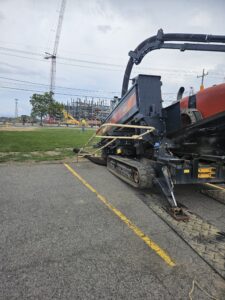
Golf Course and Residential Crossing
Our directional drilling services for golf course crossings allow seamless installation of water, irrigation, and communication lines while preserving fairways and greens with minimal surface disruption.
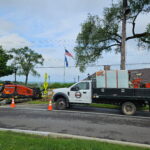
Roadway Crossing
By drilling beneath roads, highways, and railways, directional drilling allows for the safe installation of utilities without requiring open-cut excavation, minimizing traffic disruptions and preserving existing infrastructure.
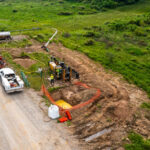
Environmental Area Crossing
Directional drilling enables utility installation beneath rivers, wetlands, protected lands, and other environmentally sensitive areas while avoiding surface disturbance and complying with strict environmental regulations.

Urban Area Installation
In dense urban environments where surface excavation is impractical, directional drilling allows for precise underground utility placement while avoiding interference with existing buildings, sidewalks, and other utilities.
Applications
Conduit construction plays a critical role in Horizontal Directional Drilling (HDD), directional boring, and other trenchless methods for installing underground infrastructure. Here’s an overview of its applications across different utility installations:
In Horizontal Directional Drilling (HDD) and Directional Boring, conduit construction allows for installing conduits underground without the need for large open trenches, making it ideal for water, gas, electrical, or fiber optic installations. The process begins with drilling a pilot bore along a predetermined path, followed by enlarging the hole using a reamer. Once the borehole is appropriately sized, the conduit—such as HDPE or PVC—is pulled through as the drill string retracts. This method minimizes surface disruption and enables installations beneath obstacles like roads, rivers, buildings, and existing utilities.
In Trenchless Technology applications, conduit construction is widely utilized for laying underground utility pipelines and cables, particularly in urban environments where traditional excavation would be impractical. Methods such as HDD, pipe bursting, and micro-tunneling are employed to install or replace conduits while reducing environmental impact. These methods provide enhanced durability and long-term protection for underground utilities.
For Electrical and Fiber Optic Installations, conduit material selection is critical. Electrical systems typically use rigid PVC, HDPE, or metal conduits to protect cables, while fiber optic networks often rely on innerduct or flexible HDPE conduits to shield sensitive fiber optic lines. These conduits offer protection against physical damage, moisture, and environmental wear, while also simplifying future upgrades and ongoing maintenance.
In Duct Bank Installation, HDD or other trenchless methods allow for the installation of multiple conduits grouped together without requiring traditional excavation. This approach supports redundancy, future expansion, and efficient power distribution across industrial, commercial, or residential areas.
With Joint Trench Construction, multiple utility lines—including electric, gas, telecom, and water—are combined into a single trench or bore path. This shared approach results in significant cost savings by reducing excavation requirements and enables more efficient use of underground space.
Conduit construction is essential because it protects utilities from environmental and mechanical damage, streamlines installation and future maintenance, complies with local utility regulations for safety and reliability, and allows for scalable growth by simplifying the addition of new utilities with minimal disruption.
By integrating conduit construction with modern trenchless methods, utility companies and contractors achieve cost-effective, sustainable, and long-lasting underground infrastructure solutions.